The
Twelver Shi`i-Shaykhi Baraghani Family
and
Fātima-Ṭāhira-Qurrat
al-`Ayn (d.1852 CE)
Stephen Lambden (UC-Merced)
IN PROGRESS 2009-10
A SHI`I-SHAYKHĪ BARAGHĀNĪ-QAZVĪNĪ FAMILY.
Baraghan is a village between
Qazvīn and Tehran
The Nores below are partly based on Momen,
2003:317ff who draws on sections within Muhammad Ṣāliḥ Baraghānī's,
Mawsū`a al-Baraghānī fi fiqh al-shi`a (n. p. 1985).
-
Shaykh Muhammad Kāẓim
Taliqanī (d. 1094/1683), a student of Bahā al-Dīn al-`Āmilī
(d.`1031/1622) and Mir Damad (d.1041 /1631), the "progenitor of the Baraghānī
family" .
-
Shaykh Muhammad Ja`far
Firishtah (d. 1XXX/1XXX), son of the above.
-
Shaykh Muhammad Taqī
(d. 1161/1748).
-
-
Shaykh Muhammad
Mala'ikah Baraghānī (d. 1200/1785) married Fāṭima who were the
parents of the three sons listed below:
-
-
[1]
Mullā Muhammad Taqī
[Baraghānī] al-Qazvīnī (c. 1167 [?83] -1263 AH = c. 1753 ??-1847
CE), al-Shahīd al-Thālīth (The
Third Martyr), anti-Shaykhi-Babi uncle of Fāṭima Baraghani = Ṭāhira,
Qurrat al-`Ayn (d.1852 CE). He married a daughter
of Fath `Ali Shah who bore him three sons. He was "the first cleric
to declare takfīr or (loosely) "excommunication"(ca. 1238/1822) against Shaykh Aḥmad Ahsā'ī and
subsequently became the leading opponent of Shaikhism in Iran. He
studied in Iran and Iraq, and accompanied his teacher, Moḥammad-`Alī
Ṭabāṭābā'ī on the 1242/1826 jihad against Russia. After a
disagreement in Tehran with Fatḥ-`Alī Shah, he returned to
Qazvīn, where he acquired a reputation as one of the best preachers
of his day.." (MacEoin, EIr. ADD). He was an uncle of Fāṭima
Baraghani = Ṭāhira and became one of the
leading, pioneer Usuli Shi`i clerics of Qazvin.
-
-
See further Tunukabūnī, Mirza
Muḥammad ibn Sulaymān (c. 1234-1302 AH =1819-1884 CE), Qiṣas al‑`ulamā.
1st ed. [Tehran] n.p. n.d. [1887-8] No. 2 = Hajji Mulla Muhammad Taqī
ibn Muhammad Baraghānī al-Qazvīnī +
recent 2004 editin = Qiṣas al‑`ulamā. ed. Muhammad Rida' Barzgar Khaliqi
and Uffat Karbasi. Tehran: Intisharat `Ilmi va Farhang, 1383Sh/2004
(xxxiv+777+1 pp.) On No. 2 in this edition see pp. 22-76 which
contains useful information about Shaykh Ahmad al-Ahsa'i and his takfir
("excommunication") as well as other issues within Shaykhi
history.
-
-
[2] Mullā Muhammad Ṣāliḥ
Baraghānī / Qazvīnī (c. 1167-1271 AH [?] = c.1761-1854
CE) the father of Fāṭima Baraghānī entitled Ṭāhira (d.1852 CE).
He founded an important Madrasa in Qazvin known as the Ṣāliḥiyya at
which several sons of Shaykh Aḥmad al-Ahsā'ī (d.1241/1826)
were instructed for a while (noted Momen, 2003). On him
and his writings see Tunukabūnī, Mirza Muḥammad ibn Sulaymān,
Qiṣas al‑`ulamā. ed. Muhammad Rida' Barzgar Khaliqi and Uffat Karbasi.
Tehran: Intisharat `Ilmi va Farhang, 1383Sh/2004 (xxxiv+777+1 pp.) He is
No. 5 in this edition see pp. 108-109 which contains useful
information about Mullā Muhammad Ṣāliḥ
Baraghānī, Qazvīnī and his Arabic and
Persian writings.
-
-
[3]
Mullā Muhammad `Alī
Baraghānī / Qazvīnī (c.
1175-1272 A H= c.1761-1854 CE) an uncle of Fāṭima
Baraghānī = Ṭāhira. He was a mystically
oriented teacher at the Ṣāliḥiyya of his brother and obtained an
ijāza from Shaykh Aḥmad al-Ahsā'ī (d.1241/1826). He subsequently
became an enthusiastic Shaykhi and seems to have sympathized
with the religion of the Bāb.
-
-
Fāṭima Baraghānī entitled Ṭāhira
(The Pure One), Qurrat al-`Ayn ("Solace of the Eyes") and Zarrin Taj
(Crown of Gold) the eldest daughter of (the above [2]) Mullā Muhammad
Ṣāliḥ al-Baraghānī [al-Qazvini] and Amina
(1202-1268 AH= 1787-1851). She was a Shi`i, Shaykhi and
ultimately Bābī apologist and martyr (d. 1852 CE ).
-
Fāṭima Baraghānī,
- Qurrat al-`Ayn - Ṭāhirih (c. 1817-1852)
She today best known as Tahirih (the "Pure One") and as a revolutionary Babi believer. Before coming
to faith in the Bab (1819-1850) in 1260/1844 she (like other members of her
family) was a very learned and accomplished adherent of the Shaykhi school
whose founding master Shaykh Ahmad and leader, Sayyid Kazim Rashti, she
greatly admired. She came to be known by several titles, including Zarrin Tāj (Crown of
Gold) and Qurrat al-`Ayn (Solace of the Eyes)There exist perhaps forty
to fifty or more books and papers about Tahira several of which
have recently been published.
This dynamic, charismatic
and extraordinarily learned Persian woman was enraptured by the person and
teachings of the first two Shaykhī leaders. In 1260/1844 she, along with her
cousin and a number of other Shaykhis, were numbered among the first disciples
of Sayyid `Ali Muhammad Shirazi, the Bāb, the Hurūfāt al-Ḥayy (the 18 "Letters of the Living"). Ṭāhira
remained a devoted and revolutionary Bābī, (follower of the the Bab), from the very beginning of his
messianic career until she was brutally executed in 1852.
For
biographical details see : URL :
For useful biographical
and family details see Moojan Momen,
`Usuali, Akhabri, Shaykhi, Babi: The
Tribulations of a Qazvin Family' in `The Journal for the Society for Iranian
Studies', Iranian Studies vol. 36/3 (Sept. 2003) 317-337.
The vast
majority of the Arabic and Persian writings of Tahira (aside from a
portion of her Persian and Arabic poetry which has not been wholly
collected) have not been critically edited, collected or translated.
Baha'i generated materials including books about Ṭāhira include:
Mulla Muhammad
Nabil-i Zarandi (d.1892 CE) [Shoghi Effendi ed. and trans.]
Fāḍil-i
Māzandaranī,
Hussam
Nuqaba'i
Nusratu'llah
Muhammad Husayni,
Abu'l-Qasim
Afnan (d. XXXX)
Martha L. Root,
-
Tahirih
The Pure, 1st ed. Karachi, 1938.
-
Rep.
Kalimat Press Los
Angeles, ADD...
"Martha Root became fascinated by Táhirih's
story and traveled to Iran in an effort to learn more about this
remarkable woman. This book is the result of her research. .."
Though most of Tahirih's theological and apologetic Shaykhi and Babi
writings and the bulk of her poems remain unpublished, several volumes have
recently been published about Tahirih and her poetry including:
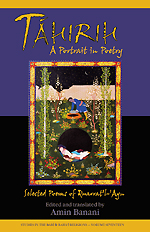
Amin Banani (edited and
translated)
Tahirih, A Portrait in Poetry-- Selected Poems of Qurratu'l-`Ayn
(=
Studies in the Babi and Baha' religion vol. 17). Kalimat Press Los Angeles,
2004. ISBN 1-890688-36-3 HBk. vi+145 pp. Contains an opening essay entitled
' A Woman for Our Time' (pp.1-30) followed by another by Jascha Kessler, `On
Translating a Persian Mystical Poet' (pp.31-38) and an Editor's (Tony Lee's)
Note (pp. 39-43). A selection of Tahirih's poems in the original Persian
(+Arabic) with English translation by Banani (and Kessler) occupy pages
45-105. Notes by Banani briefly supplement and clarify aspects these texts.
See further, URL:
http://www.kalimat.com/Tah-Poetry.html
TAHIRIH IN HISTORY:
Perspectives on Qurratu'l-'Ayn from East and West Edited by Sabir Afaqi
The volume brings together most of what we know about Tahirih
Qurratu'l-'Ayn. Included is history from: 'Abdu'l-Baha and Shoghi
Effendi; the work of scholars in India and Pakistan; and essays by
Western scholars, such as E. G. Browne, A.-L.-M. Nicolas (translated
from French), Abbas Amanat, Farzaneh Milani, and others. Kalimat Press
Los Angeles, ADD...
